
Route Model Binding Explained
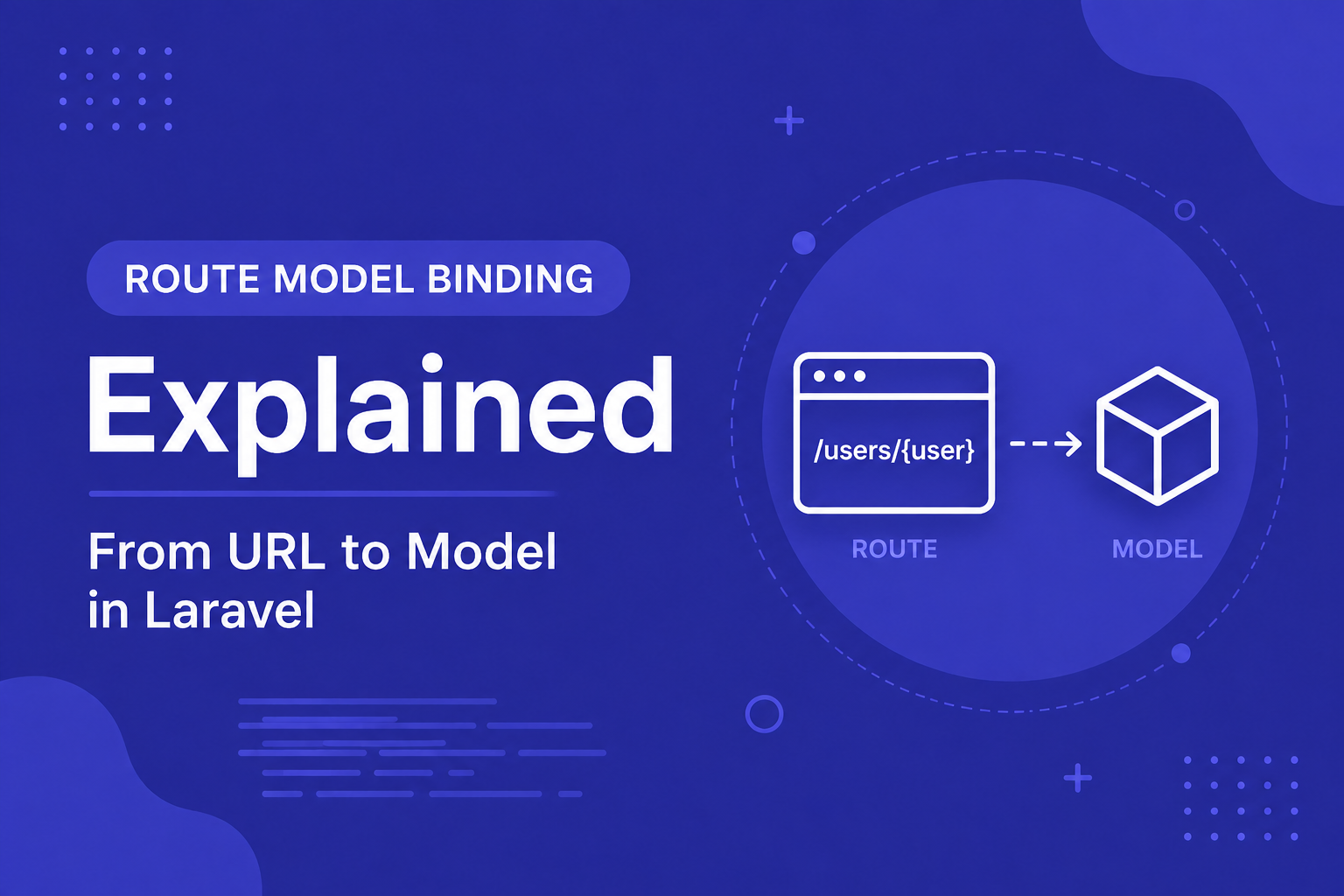
In this final article of our Routing & Controllers, we'll explain how route model binding works, the difference between implicit and explicit binding, and how to customize it for more advanced use cases.
90 views
Introduction
Throughout this series, you've seen route parameters like {id} passed into controller methods as plain values — a number pulled directly from the URL. In practice, though, the very first thing most developers do with that ID is use it to look up a matching record in the database, usually with something like Post::findOrFail($id).
Since this pattern is so common, Laravel offers a feature that automates it entirely: route model binding. Instead of manually looking up a record by its ID inside every controller method, Laravel can do it for you automatically, injecting a fully-loaded model instance directly into your method instead of a raw ID.
In this final article of our Routing & Controllers, we'll explain how route model binding works, the difference between implicit and explicit binding, and how to customize it for more advanced use cases.
The Problem Route Model Binding Solves
Without route model binding, a typical controller method looks like this:
php
public function show($id)
{
    $post = Post::findOrFail($id);
    return view('posts.show', ['post' => $post]);
}
This works fine, but you end up repeating the same findOrFail() lookup in nearly every method that deals with a specific record — show, edit, update, destroy — all doing the exact same lookup pattern. Route model binding removes this repetition entirely.
Implicit Route Model Binding
Implicit binding is the simplest and most commonly used approach. Instead of naming your route parameter {id}, you name it after the model itself, and type-hint the model class in your controller method.
php
Route::get('/posts/{post}', [PostController::class, 'show']);php
use App\Models\Post;

public function show(Post $post)
{
    return view('posts.show', ['post' => $post]);
}
Here's what happens behind the scenes: Laravel sees that the route parameter is named {post} and that the controller method expects a Post model. It automatically runs the equivalent of Post::findOrFail($post) for you, using the value from the URL as the primary key, and injects the resulting model instance directly.
If no matching record is found, Laravel automatically returns a 404 response — you don't need to write any error handling for that case yourself.
Implicit Binding with Resource Controllers
Implicit binding pairs especially well with resource controllers, since Laravel automatically applies it to the standard CRUD methods:
php
Route::resource('posts', PostController::class);php
public function show(Post $post)
{
    return view('posts.show', ['post' => $post]);
}

public function edit(Post $post)
{
    return view('posts.edit', ['post' => $post]);
}

public function update(Request $request, Post $post)
{
    $post->update($request->all());
    return redirect()->route('posts.show', $post);
}

public function destroy(Post $post)
{
    $post->delete();
    return redirect()->route('posts.index');
}
Notice there's no manual lookup anywhere — every method receives a ready-to-use Post instance directly.
Customizing the Lookup Column
By default, implicit binding looks up records using the model's primary key (usually id). If you'd rather look up a record using a different column, like a URL-friendly slug, you can specify this directly in the route definition:
php
Route::get('/posts/{post:slug}', [PostController::class, 'show']);This tells Laravel to run the equivalent of Post::where('slug', $value)->firstOrFail() instead of using the primary key, without changing anything in your controller method itself.
Explicit Route Model Binding
Explicit binding gives you more control by defining the binding logic yourself, typically inside a service provider. This is less common for simple applications but useful when you need custom resolution logic.
php
// In App\Providers\AppServiceProvider (boot method)
use Illuminate\Support\Facades\Route;
use App\Models\Post;

Route::bind('post', function ($value) {
    return Post::where('slug', $value)->firstOrFail();
});
With this in place, any route using {post} will use this custom logic to resolve the model, regardless of the controller method's type-hint.
In practice, most developers reach for the simpler {post:slug} syntax shown earlier rather than defining fully explicit bindings, since it accomplishes the same result with far less code.
Tips for Using Route Model Binding
Match your route parameter name to the model variable name in your controller method — this is what makes implicit binding work automatically.
Use
{model:column}syntax when you need to look up by something other than the primary key, like a slug, instead of writing custom binding logic.Combine model binding with resource controllers for the cleanest possible CRUD implementation, avoiding manual lookups entirely.
Remember that a 404 is automatic — you don't need to write
findOrFail()error handling yourself when using implicit binding.Use explicit binding sparingly, only when your lookup logic is too complex for the simple
{model:column}shorthand to handle.
FAQ About Route Model Binding
1. What happens if the ID in the URL doesn't match any record? Laravel automatically returns a 404 Not Found response, the same way findOrFail() would, without you needing to write any additional error handling.
2. Does route model binding work with route model constraints, like whereNumber()? Yes, you can combine them. The constraint validates the format of the parameter, while binding handles the actual database lookup, and both work together seamlessly.
3. Can I use route model binding with multiple models in a single route? Yes. For example, Route::get('/posts/{post}/comments/{comment}', ...) can bind both a Post and a Comment model simultaneously, as long as both parameters match their corresponding model variable names in the controller.
4. What's the difference between implicit and explicit binding in terms of when to use each? Implicit binding (including the {model:column} syntax) covers the vast majority of use cases and should be your default choice. Explicit binding is only needed for genuinely custom resolution logic that can't be expressed with the simpler syntax.
5. Does route model binding work with soft-deleted records? By default, implicit binding excludes soft-deleted records (records marked as deleted but not actually removed from the database). If you need to include them, you can chain ->withTrashed() onto the route definition.
6. Is route model binding only available for web routes? No, it works the same way for API routes defined in routes/api.php, making it just as useful for building JSON APIs as it is for traditional web applications.
Conclusion
Route model binding is one of those Laravel features that quietly removes an enormous amount of repetitive boilerplate from your controllers, letting you work directly with fully-loaded model instances instead of manually fetching records by ID every time. Once you get used to it, going back to manual lookups feels unnecessarily tedious.
With this article, we've now completed the full Routing & Controllers category — from the basics of GET, POST, PUT, and DELETE routes, through parameters, named routes, controllers, resource routes, middleware, and finally route model binding. You now have a solid, practical foundation for handling how requests flow through a Laravel application from start to finish.
Found this helpful? Share it!